
The kitchen is not just a place for cooking; it is the heart of the home and a key factor in resale value. When undertaking a kitchen renovation, cabinets represent the largest visual element and often the most significant budget investment. The door style and material you choose will dictate your kitchen’s overall aesthetic, durability, and final cost.
With an overwhelming number of options available, making a decision can be difficult. This guide simplifies the process by deeply exploring the most popular cabinet door styles—Flat (Slab), Shaker, and Slim Shaker—and the mainstream materials used to construct them: Particle Board, MDF, HDF, and Solid Wood.
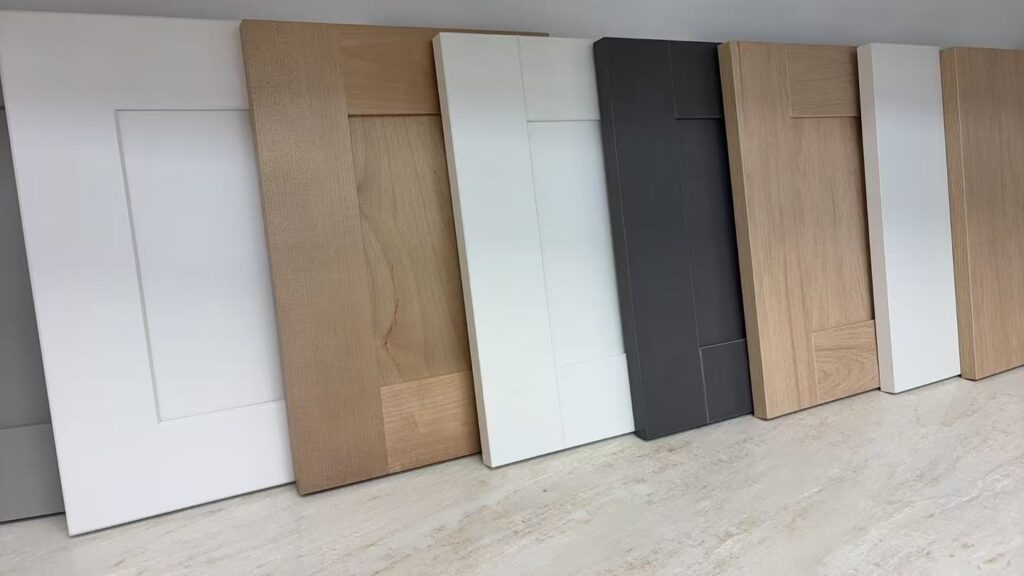
Part 1: Trending Door Styles Dictating Kitchen Aesthetics
The door style defines the “face” of your kitchen—whether it is modern and minimalist, classic and cozy, or sophisticated and transitional.
1. Flat (Slab) Panel Doors
- Style Keywords: Minimalism, Modern, Contempoary, Sleek, Handleless.
- Characteristics: Exactly as named, this door is a single, flat, smooth piece without any decorative raised panels or frames. It is often paired with hidden grooves (Gola profiles) or touch-latch mechanisms for a seamless, handleless finish.
- Advantages:
- Clean Visuals: The sharp, uninterrupted lines create a clean, open look, making it ideal for small kitchens or those desiring a purely contemporary space.
- Easiest to Clean: There are no crevices or grooves where grease and dust can accumulate; a quick wipe is all it needs.
- Excellent Material Display: It is the best choice for showcasing specialized materials or textures, such as stone veneer, high-gloss finishes, or smooth matte laminate.
2. Shaker Doors (The Versatile Classic)
- Style Keywords: Timeless, Transitional, Farmhouse, Craftsman, Adaptable.
- Characteristics: The Shaker door is arguably the most resilient design trend worldwide. It features a five-piece construction: a flat rectangular panel in the center (Recessed Panel), enclosed by a four-part frame (Stiles and Rails). It is defined by its simple, clean, square profile.
- Advantages:
- Versatility: Shaker doors can integrate seamlessly into almost any home style. Depending on the color and hardware chosen, they can appear traditional, modern, or anywhere in between.
- Dimension and Depth: They provide more visual texture and structure than a flat slab but remain sleek enough for modern sensibilities.
- Timeless Appeal: Their simple elegance ensures they rarely look dated, making them a safe investment for long-term home value.
3. Slim Shaker Doors (The Micro-Shaker)
- Style Keywords: Sophisticated Transitional, Refined Modern, Modern Light Luxury, Japandi.
- Characteristics: This is the current, high-demand evolution of the traditional Shaker. It maintains the frame-and-panel structure, but the width of the framing pieces is significantly narrowed (often from the classic 2–3 inches down to 1 inch or less). It is also known as a “Skinny Shaker.”
- Advantages:
- Refined Modernity: The narrow frame creates a much leaner, more delicate visual profile, offering a sophisticated, design-forward alternative to standard Shaker doors.
- Rich Detail: It provides the dimension of a Shaker while adhering to the minimal footprint of a contemporary look, perfect for those seeking detailed quality without fuss.
Part 2: Essential Materials Deciding Durability and Cost
Once you have chosen an aesthetic, you must understand the core material that supports it. Cabinet material determines moisture resistance, structural stability, and the type of finish (paint, stain, or laminate) that can be applied.
1. Particle Board (Chipboard)
- Overview: Made from wood particles and shavings bonded together under heat and pressure. In cabinetry, it is almost always finished with Melamine (laminated paper).
- Best Suited Style: Flat (Slab) doors.
- Pros & Cons:
- ✅ Highest Affordability: The most budget-friendly choice for both developers and homeowners.
- ✅ Stable Core: The construction makes it less prone to warping compared to some other materials.
- ✅ Durable Surface: High-quality melamine surfaces are scratch-resistant and easy to maintain.
- ❌ Poor Moisture Resistance: This is its critical flaw. If water penetrates the edge banding, the core material can swell dramatically (known as “blown edges”) and degrade quickly.
- ❌ Limited Styling: Cannot be routed or shaped; restricted only to flat slab designs.
2. MDF (Medium-Density Fiberboard)
- Overview: Composed of wood fibers (finer particles than particle board) and resin, compressed into extremely smooth, dense sheets. It has a uniform, fine texture.
- Best Suited Styles: Shaker, Slim Shaker, and any painted doors or intricate routed profiles.
- Pros & Cons:
- ✅ Superior Paint Surface: Because it is perfectly smooth and devoid of grain, it offers the best surface for Painted finishes. A painted MDF door is smoother than a painted solid wood door.
- ✅ Excellent Stability: It is highly stable and does not warp or crack like solid wood when exposed to changes in temperature and humidity.
- ✅ Malleability: Can be cut and routed into various detailed shapes, including the fine details of a Slim Shaker.
- ❌ Sensitive to Moisture: While better than particle board, unprotected MDF will still absorb water and swell. Special moisture-resistant grades (MR-MDF) are available for wet areas.
- ❌ Lower Screw-Holding: Screws can loosen over time if repeatedly removed and re-inserted.
3. HDF (High-Density Fiberboard)
- Overview: Similar in principle to MDF but processed under much higher pressure, resulting in a much denser, heavier, and harder panel.
- Best Suited Styles: Premium painted cabinetry, fine profiles, and highly demanding structural designs like narrow Slim Shaker frames.
- Pros & Cons:
- ✅ Exceptional Strength and Hardness: It is the strongest, most stable, and most durable of the fiberboard options. For Slim Shaker styles, where the frame is very narrow, HDF offers the best structural support.
- ✅ Finest Finish: The extremely fine composition allows for an unrivaled paint finish, achieving automotive-grade silkiness.
- ❌ Highest Cost among Engineered Woods: Considerably more expensive than MDF.
- ❌ High Weight: Puts more strain on hardware and hinges, requiring high-quality components.
4. Solid Wood
- Overview: Made from natural, solid timber. It is usually constructed using a 5-piece frame-and-panel design to accommodate the wood’s natural movement.
- Best Suited Styles: Classic Shaker, Traditional/Ornate Carved, Slim Shaker (depending on wood species). Stained or painted finishes.
- Pros & Cons:
- ✅ Natural Beauty: Possesses natural wood grain, warmth, and texture that engineered materials cannot replicate.
- ✅ Premium Appeal: It is the classic choice representing high quality and prestige, which can increase home value.
- ✅ Repairable: Scratches and dents can often be sanded out and the surface refinished.
- ❌ Natural Movement: This is its defining characteristic. Wood is hydroscopic; it expands and contracts with changes in humidity, which can lead to warping, cracking, or seam gaps if not managed properly.
- ❌ Higher Maintenance: Requires more careful management of the kitchen environment.
- ❌ Highest Cost: Prices vary significantly by wood species (e.g., Oak, Maple, Cherry) but it is generally the most expensive material.
Conclusion: Making the Right Choice for Your Kitchen
Choosing the right cabinet combination is a balance of Style Preference, Budget, and Lifestyle.
- Based on Budget:
- Tight Budget: Flat doors + Particle Board (Melamine) offer the best value.
- Mid-Budget: Shaker/Slim Shaker + MDF (Painted or Thermofoil) is the most popular, offering beauty and stability.
- Flexible/High Budget: Solid Wood (especially for staining) or HDF for a perfect painted finish.
- Based on Style:
- Strict Modern Minimalism: Flat (Slab) doors are essential.
- Warm/Transitional/Classic: Standard Shaker or Slim Shaker.
- Based on Kitchen Environment & Use:
- If you cook extensively and produce a lot of grease/smoke, Flat doors are the easiest to maintain.
- If you live in a highly humid area or want a hassle-free, long-term cabinet, stable engineered cores (MDF/HDF) may be more practical than natural solid wood.
We hope this comprehensive guide helps you make an informed decision for your kitchen renovation, allowing you to create a high-quality space that is both visually striking and functionally durable.