
Are you often left confused by the various material names tossed around by retailers when shopping for cabinets?
To avoid paying a “stupidity tax,” you first need to understand one underlying logic: a complete cabinet panel consists of two parts—the “Core (Substrate)” and the “Finish.”
- Core = Skeleton: Determines the cabinet’s load-bearing capacity, screw-holding power, and resistance to warping.
- Finish = Skin: Determines the visual appeal, scratch resistance, and ease of daily cleaning.
Next, we will deconstruct these two core components from the most objective and level-headed perspective.
Part 1: The Core (Skeleton) — The Invisible Hero Dictating Cabinet Lifespan
There are three commonly used core materials in modern cabinetry. Before diving into them, ask yourself this question: Do you want to spend your budget on invisible structural premiums, or on the hardware and aesthetics you can see and feel every day?
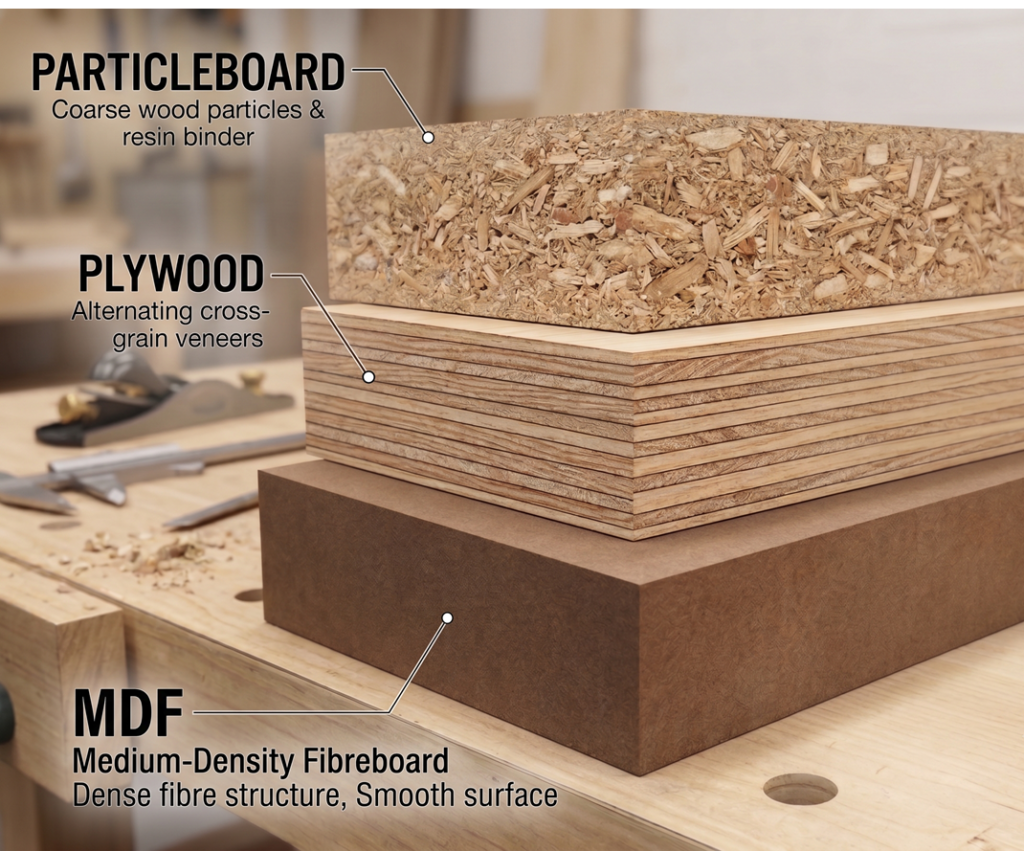
1. Particleboard (PB)
This is made by crushing wood into particles and pressing them with resin under high temperature and pressure. The vast majority of modern North American cabinet boxes are PB-Boxes.
- Pro – Extreme Stability: Because the internal structure consists of crisscrossed particles, it breaks the physical stress of natural wood, making it highly resistant to warping.
- Pro – High Economic Efficiency: It has a low initial investment cost, making it the absolute king of cost-effectiveness.
- Pro – Flat Surface: Extremely suitable for pressing various modern finish materials.
- Con – Weaker Moisture Resistance: If poor edge banding allows long-term water penetration, particleboard will swell (though modern PUR edge banding technology has largely solved this issue).
2. Plywood
Made by gluing together multiple thin layers of wood veneer with alternating grain directions.
- Pro – Excellent Moisture Resistance: Even if submerged in water, it is much less likely to swell and blister severely like particleboard.
- Pro – Strong Screw-Holding Power: Screws bite tighter into the material.
- Pro – Lighter Weight: Easier to transport and hang on walls during installation.
- Con – Low Economic Efficiency: The cost is significantly higher than PB.
- Con – Limited Flatness: The surface is not as perfectly flat as PB or MDF. If used for high-gloss doors, a “wavy” effect can easily occur.
- Con – Warping Risk: In extremely dry environments or areas with drastic humidity changes, thinner plywood doors carry a physical risk of warping.
3. MDF (Medium Density Fiberboard)
Made by breaking down wood fibers into a fine powder and pressing them with resin.
- Pro – Extremely Fine Texture: The surface and edges can be precisely milled and routed (for example, classic recessed Shaker door frames are often carved from a single piece of MDF).
- Pro – Perfect Base for Paint: Because it has no wood grain or particles, the painted surface is exceptionally smooth.
- Con – Heavy Weight: It is extremely heavy.
- Con – Water Swelling Risk: It has a high swelling rate when exposed to water. It is absolutely not suitable for cabinet boxes that might frequently contact water; it is primarily used for doors.
Part 2: The Finish (Skin) — The Surface Work Dictating Your Maintenance Cost
Now that the skeleton is chosen, what clothes should it wear? Different finishes directly dictate your household chore energy and maintenance costs for the next decade.
1. Melamine (Thermally Fused Laminate)
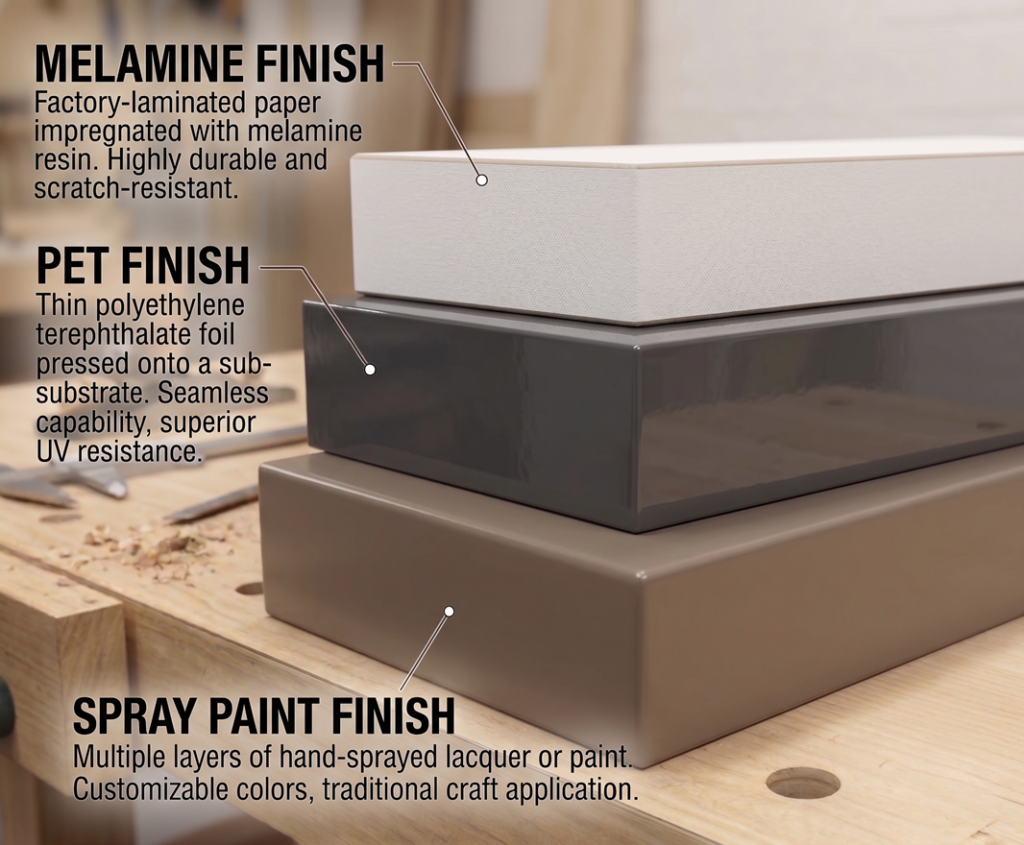
This is a process where paper printed with colors or wood grains is saturated in resin, dried, and thermally fused onto the core surface.
- Pro – Extremely Rugged: Wear-resistant, scratch-resistant, and heat-resistant. Zero stress for daily cleaning, making it the perfect choice for heavy-duty work zones like kitchens.
- Pro – High ROI: Budget-friendly with an extremely rich variety of styles and textures.
- Con – No 3D Profiles: Cannot be routed; it can only be used for Slab Doors.
- Con – Irreversible Damage Risk: This is its biggest weakness. While the surface is hard, once a deep scratch or chip occurs, it is completely unrepairable. You cannot sand or touch it up with paint; you can only spend money to scrap and replace the entire door.
2. PET (Thermal Plastic)
PET is a food-grade, eco-friendly plastic film applied to the board’s surface via a flat lamination process.
- Pro – Premium Texture: Can achieve an ultimate “Super Matte” or “High Gloss” mirror finish.
- Pro – Anti-Fingerprint & Anti-Yellowing: Premium matte PET has excellent anti-fingerprint properties and resists yellowing over long-term use.
- Con – Higher Cost & No Profiles: It also cannot be used for complex 3D profiles, and it costs more than Melamine.
- Con – Equally Unrepairable: Sharing the same logic as Melamine, once severely scratched by a sharp object, the disfigurement is permanent. There is no solution other than replacing the door.
3. Paint/Lacquer
A painted finish achieved by multiple coats of spraying, sanding, and drying directly on the core (usually MDF).
- Pro – Seamless Integration: There is no edge banding. The edges are perfectly wrapped, offering exceptional resistance to moisture intrusion.
- Pro – Design Freedom: Can perfectly cover doors with complex carved profiles.
- Pro – Ultimate Repairability (Core Advantage): Unlike other finishes that are “ruined once scratched,” a painted surface possesses the ability for infinite rebirth. If scratches or dents occur, they can be flawlessly repaired through sanding, filling with putty, and localized repainting, drastically reducing hidden long-term replacement costs.
- Con – High Economic Cost: The process is extremely labor-intensive, requiring the highest initial investment.
- Con – Softer Texture: The physical hardness of paint is indeed lower than Melamine and PET; it is softer. Therefore, it is more susceptible to scratches and dents from hard objects in daily use (though this is perfectly hedged by its outstanding repairability).
Purchasing Summary from an Investment Perspective
A logically rigorous and highly economical cabinet pairing strategy is never about blindly chasing the “most expensive,” but rather spending money where it counts:
- For the Cabinet Box: PB-Box + Melamine Finish is the universally recognized best practice in the industry. It provides extremely high structural stability and ease of cleaning while keeping the initial cost to a minimum.
- For High-Durability Needs (Modern Slab): If you have active kids or pets and want a virtually indestructible kitchen, choose a PB/MDF Core + Melamine or PET Finish for the doors. It is incredibly easy to maintain, but you must accept the premise that “once scratched, the door must be replaced.”
- For Classic Texture and Long-Term Value Retention (Classic Shaker): Choose an MDF Core + Paint/Lacquer Finish for the doors. Although it is softer and requires a higher initial investment, its unique seamless beauty and “sandable & repairable” nature grant it a lifespan that spans economic cycles. In the long run, the return on investment is exceptionally high.
Before making your final decision, ask yourself one more time: Is your kitchen a “battleground” for intense daily cooking, or a “showroom” for occasionally brewing a cup of coffee? Once you clarify your usage scenario and long-term maintenance expectations, the most suitable material combination for you will naturally reveal itself.